
Routes
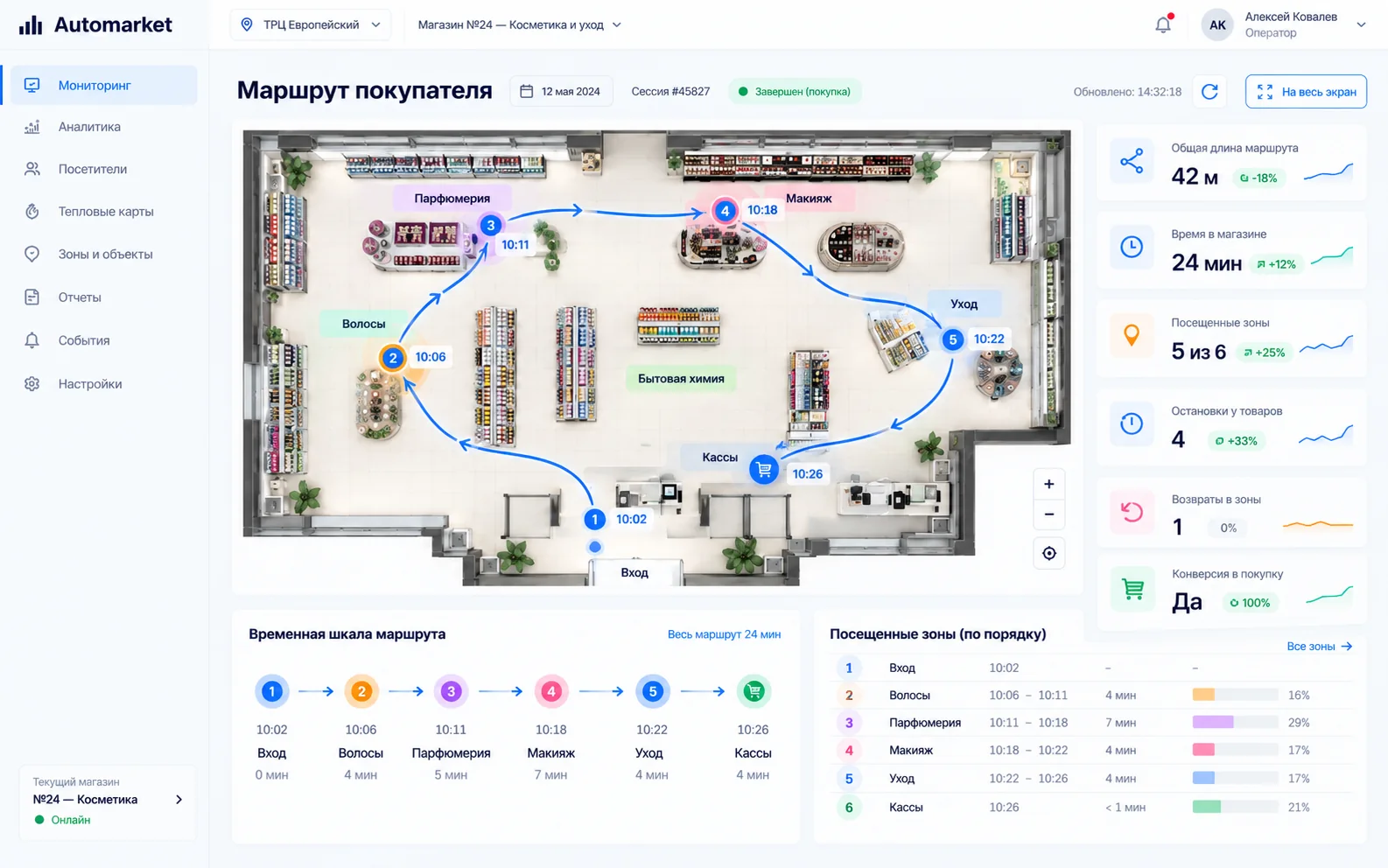
The actual path of a person, basket or order and its deviation from the optimum
We show how staff, customers and equipment move indoors. Precise data and AI analytics help reduce losses, optimise routes and order picking, and improve staff efficiency and customer experience
 Automarket Visualiser
Realtime
Automarket Visualiser
Realtime
Automarket captures movement inside a site and turns it into routes, idle time, zone dwell, load peaks, heatmaps and reports for operational decisions
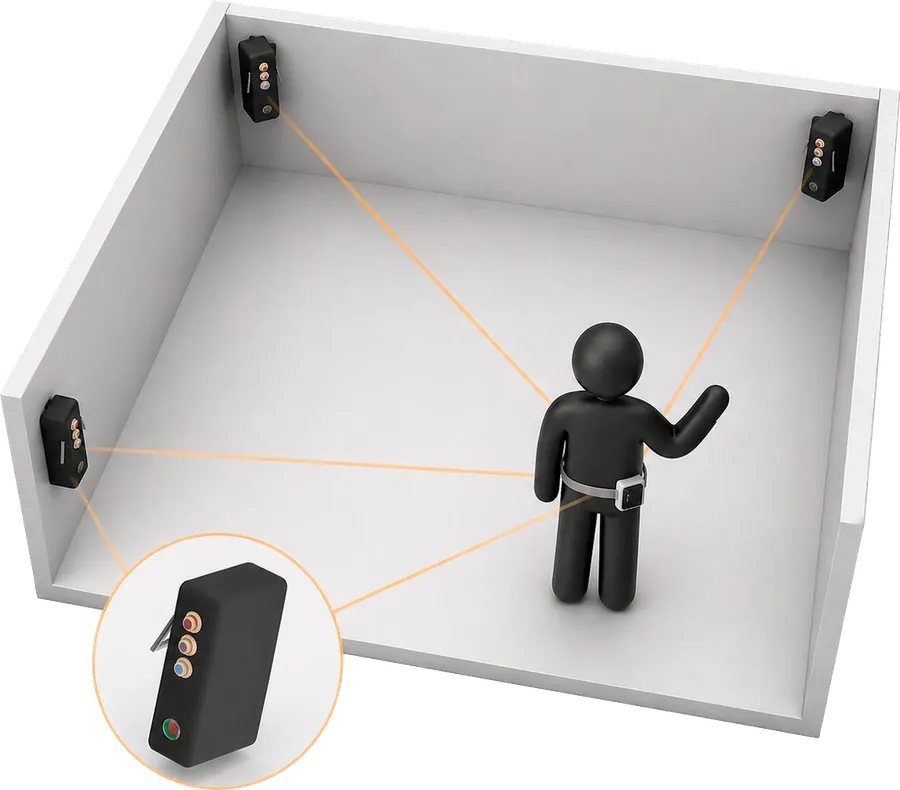
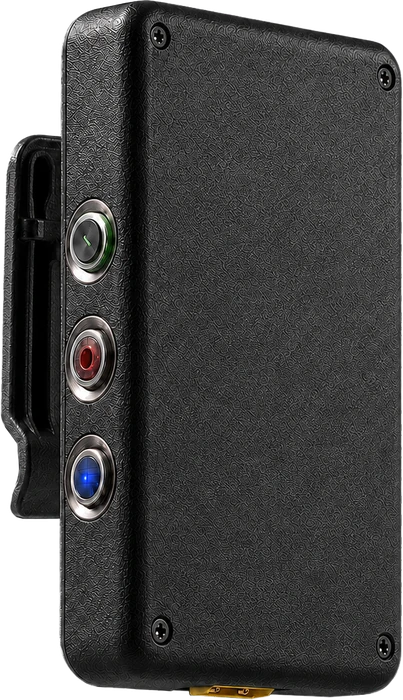
Trackers on staff, baskets, orders or equipment
Typically 3–15 points per site form the positioning infrastructure
UWB + IMU fusion, outlier filtering, signal quality scoring, trajectory recovery and smoothing
Realtime and DVR, site map, history, roles, objects and orders
Routes, stops, zones, peaks, heatmaps, reports and export
Improvement hypotheses, before/after comparison, rollout across the network
Compare shifts and scenarios, find extra walking and waiting, test layout changes and export results in a clear format
The actual path of a person, basket or order and its deviation from the optimum
When an object stopped, how long the pause lasted and in which zone it happened
Dwell time in the kitchen, buffer, aisles, checkouts and merchandising zones
When and where process density rises — the basis for reallocating staff
Path length, picking time, pick points, product search, pauses and extra passes
Movement density, bottlenecks, unused areas and overloaded aisles
With trackers on baskets: shopper routes, areas of interest, abandoned baskets
The effect of a change in layout, process or staffing
XLSX, CSV, PNG and MP4 — data flows into BI and internal systems
WMS, ERP, timesheets, receipts, orders and API — to fit the client's scenario
Swipe the cards sideways
Three screens of the web platform that pilot analytics is built on
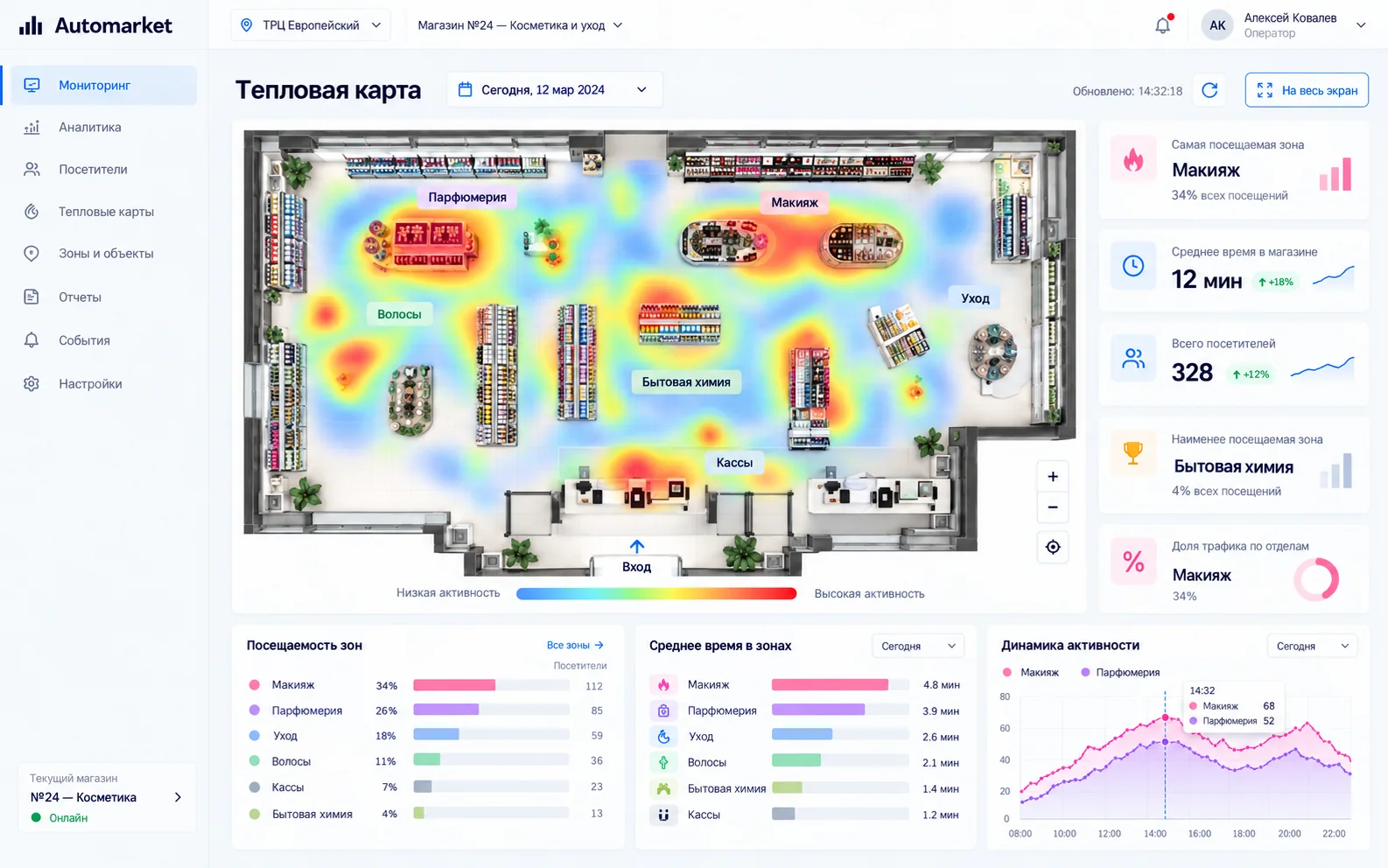
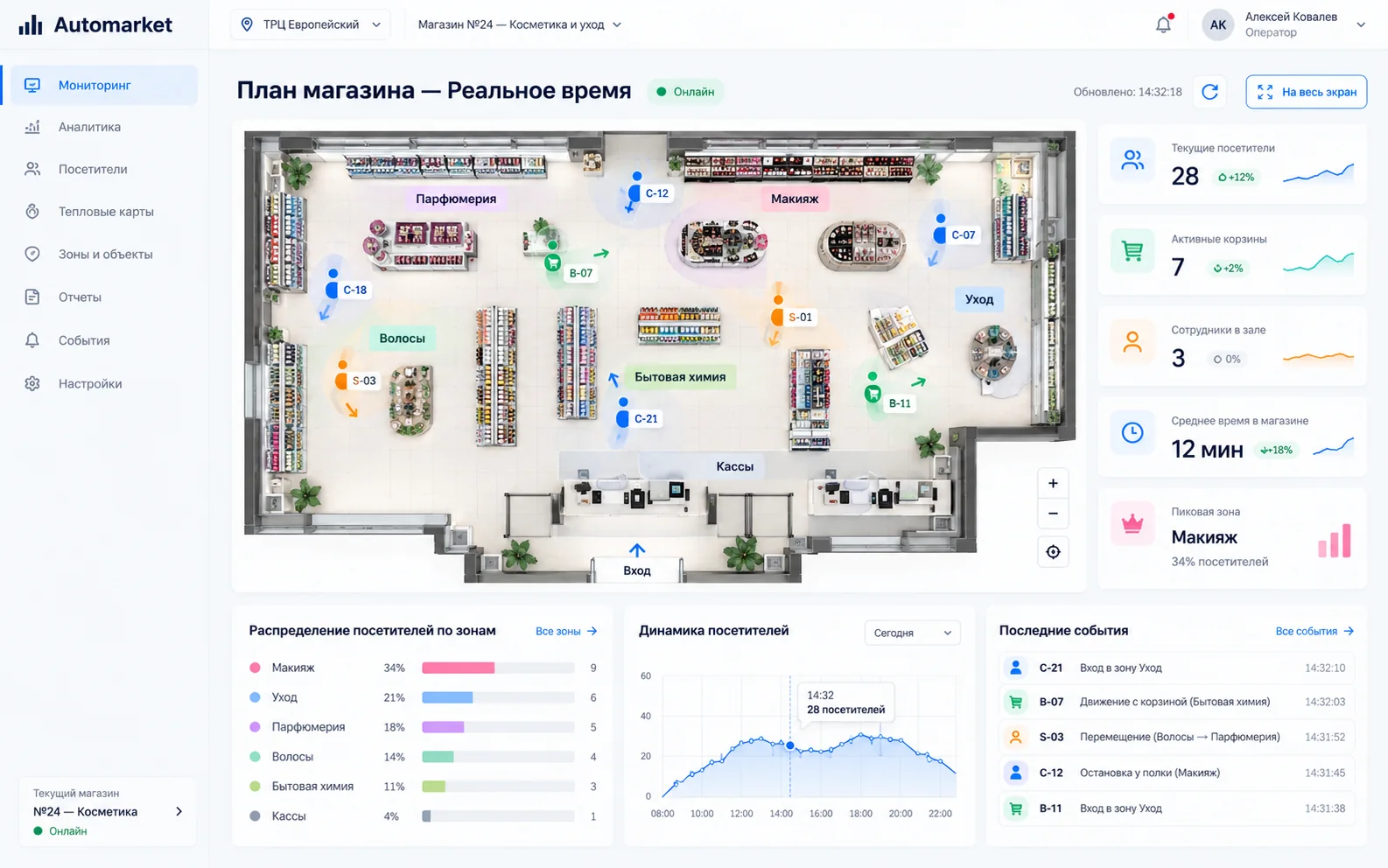
UWB + IMU is why the data can be trusted. Figures are design values and depend on the site configuration
The core stack runs on UWB and IMU — no cameras, face recognition or biometrics. Data access is role-based, and analytics can run on depersonalised tags. Video analytics can be added separately if the project needs it
Automarket can link movement data with orders, WMS/ERP, timesheets, POS data and the client's BI stack
Several operational scenarios — from dark stores to manufacturing and beyond
Order picking: routes, pauses, zone dwell time and SLA
View use caseSales floor: staff, customer path and zone load
View use casePallets, loading, people and vehicle movement, bottlenecks
View use caseMaterial flows, staff and equipment between stages
View use caseEvery project is shown with its actual status. Click a card to open a detailed case breakdown
 Yandex Lavka
Up to 20% faster picking
Optimised routes for pickers
 Yandex Market
Up to ₽1M per month per sort centre
Monitoring pallet placement in storage and loading zones
 Magnit Kosmetik
Optimising sales floor operations
Staff efficiency and service quality
One site, KPIs agreed before the start, scaling only after the impact is confirmed
Briefly about timing, data and integrations. Click a question to see the answer
A pilot lasts from two weeks to 2 months. The exact timing depends on the site, the map, the number of trackers and integrations
Staff, baskets, orders, equipment and any other objects a tag can be attached to
No. The core Automarket stack runs on UWB/IMU and doesn't need face recognition. Video can be used separately as an extra source if the project needs it
Yes. The architecture supports data export and integrations with WMS/ERP, orders, timesheets, receipts and your BI stack
A map of actual routes and zones, a set of operational metrics, exports and conclusions on improvement hypotheses
Yes. Zones, events, reports and integrations are configured for the specific pilot task
Companies we develop the technology and projects with
Magnit VkusVillYandex Lavka
 X5 GroupYandex Market